
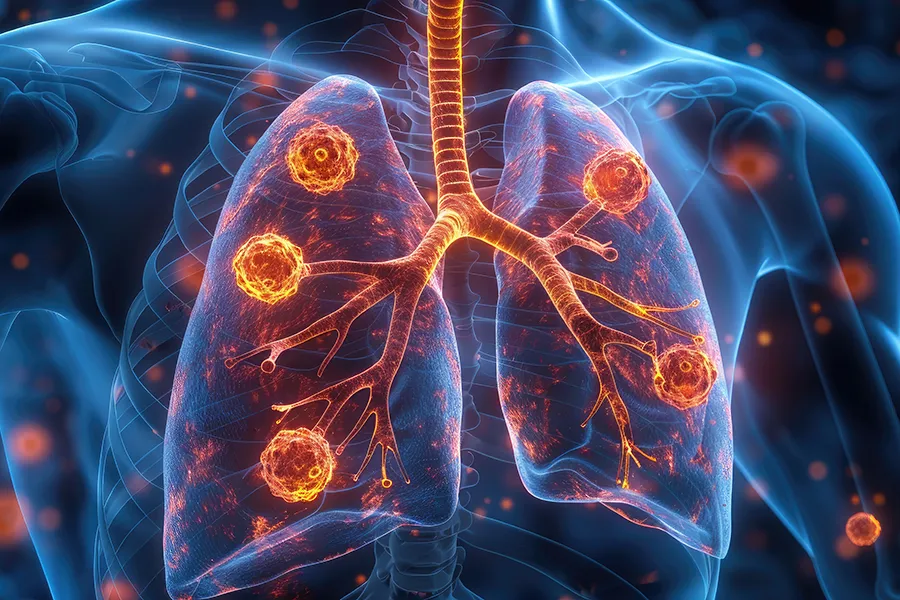
Sarcoidosis is a chronic, inflammatory disorder, characterized by the accumulation of granulomas in various body tissues. Granulomas are clusters of inflammatory cells, white blood that form non-cancerous nodules that disrupt normal tissue function. While often a systemic disorder, sarcoidosis may be limited to localized organ involvement. Common areas of involvement include the lung, lymph nodes, eyes, joints and skin. The liver and nervous system may also be involved.
The cause of sarcoidosis is unknown, though it is often considered to be an autoimmune disorder. In many cases, the condition is asymptomatic and is only discovered incidentally, for example, on a chest X-ray that may have been obtained for other reasons. Alternatively, some affected individuals struggle with significant symptoms related to the organ system involved. This may include cough or shortness of breath, joint pains and swelling, enlarged lymph glands, soft tissue nodules and swellings and skin lesions.
How Common Is Sarcoidosis?
It is difficult to estimate the actual frequency of sarcoidosis because many affected individuals are asymptomatic, but the prevalence in the general population is believed to be about 10-20 cases per 100,000 population. Sarcoidosis usually presents at the age of 20-40, sometimes in older people, but is rare in children or elderly individuals.
All races and ethnic groups can be affected, but it is about 3-4 times more common in blacks, who also tend to suffer more severe disease.1 Women and men are about equally affects in most ethnic groups, but amongst blacks, women are twice as likely as men to develop sarcoidosis2.
Symptoms of Sarcoidosis
There is a wide variety of symptoms associated with Sarcoidosis. Thirty to forty percent of those affected are asymptomatic, some have symptoms limited to localized involvement while others suffer with systemic, multisystem disease.
The most common complaints in symptomatic patients are related to the respiratory system: cough, shortness of breath, and chest discomfort. Patients may also experience skin problems, including nodules and plaque-like lesions and erythema nodosum, which is characterized by painful bumps and redness on the legs. Systemic symptoms may include fevers, sweats, malaise, weight loss, and fatigue. Joint and musculoskeletal pains are also rather common, as is eye involvement which may include ocular inflammation, dryness, and visual blurring. Swelling the lymph nodes and salivary glands (parotid) may be painful and cause oral dryness.
In asymptomatic patients, well over 90% have lung involvement which can be identified on X-Ray. Typically, such patients have “hilar adenopathy” which is swelling of the lymph nodes in the chest, with or without additional lung findings. Asymptomatic patients may also have liver test abnormalities. Asymptomatic individuals often do not require treatment, but investigations are required to rule our other causes of detected abnormalities.
Less commonly, cardiac involvement can lead to cardiomyopathy and heart failure, fainting spells and heart rhythm irregularities. When the nervous system is involved, patients may complain of headaches, confusion, peripheral nerve tingling and numbness and seizures.
Lofgren Syndrome is a particular subset of sarcoidosis that presents with hilar adenopathy on chest x-ray, erythema nodosum, often with ankle and knee swelling and arthritis. It can be quite acute and associated with systemic symptoms of fatigue and malaise, but fortunately resolves in 90% of cases, usually within 2 years, never to return.
Although considered a chronic disease, the course of Sarcoidosis is variable. Many patients will experience episodes of symptomatic illness requiring treatment, only to improve and become disease free for long periods of time. Less commonly, persistent symptomatology requires ongoing medication to control disease.
Diagnosis of Sarcoidosis
It can be challenging to diagnosis Sarcoidosis because it mimics a number of other conditions. a Comprehensive laboratory and x-ray testing is important and a biopsy of affected tissue is often required. Although blood test abnormalities are common, most are not specific for sarcoidosis.
Patients often exhibit mild anemia, liver test abnormalities, and elevated calcium levels. Inflammatory markers, such as ESR and C reactive protein may be elevated. Autoantibodies are occasionally seen.
Serum elevation of Angiotensin Converting Enzyme (ACE) is present in about 75% of cases. This is perhaps the most useful test in considering the diagnosis, since it is not often elevated in other conditions.
The Chest X-Ray is very important in evaluating Sarcoidosis patients because pulmonary system involvement is so common. Findings on chest radiographs can be staged I-IV depending upon the extent of involvement, which ranges from hilar adenopathy (enlarge chest lymph nodes) alone, to extensive lung tissue involvement with nodular scarring and pulmonary fibrosis.
Additional pulmonary studies are often employed, including CT and PET scans and pulmonary function testing. These tests provide additional information and help to assess the extent and severity of disease.
A biopsy is the means to establish a definitive diagnosis of sarcoidosis, in which “non-caseating granulomas” are detected in the tissue sample3. A biopsy may be taken from any affected region of the body. In the case of affected skin or skin nodule or a lymph node, tissue sampling is relatively minor. If not available, a liver or lung biopsy may be needed, which is more invasive. A biopsy may not be necessary is the diagnosis is otherwise strongly suspected and other causes have been excluded.
Conditions Mimicking Sarcoidosis
Sarcoidosis can mimic a number of other conditions, including tuberculosis, fungal infections, lymphoma and Hodgkin’s Disease, hepatitis, Sjogren’s Syndrome, rheumatoid arthritis, vasculitis, so it is important to consider these conditions and exclude them.
Many of the lung findings in Sarcoidosis appear quite similar to those seen in TB. Moreover, TB is also characterized by granulomas in tissues affected, so at times, even when a biopsy is taken, it can be difficult to distinguish between these conditions. The granulomas of TB have a central zone of necrosis and are called caseating granulomas. Sarcoidosis granulomas are non-caseating. A skilled pathologist can make this distinction.
It is also important to rule out TB by either culturing sputum, performing a skin ( PPD) test, or a blood Quantiferon Gold test.
If Lymphoma or Hodgkin’s disease is suspected, a tissue biopsy will be required to exclude malignant disease.
Some patients with sarcoidosis have prominent joint pains and swelling which can look much like rheumatoid arthritis. If salivary and eye involvement is present, Sjogren’s syndrome may be considered.
While it is usually not difficult to distinguish between these conditions, given the substantial clinical overlap of signs and symptoms, it is important to consider all diagnostic possibilities. An experienced physician, usually a rheumatologist or pulmonologist is required.
What is the Cause of Sarcoidosis?
The specific causes of sarcoidosis remain unknown4. It is believed that environmental antigens: immune stimuli result in the development of inflammatory granulomatous reactions5. But no one has been able to determine exactly what the specific triggers are. Sarcoidosis is not an infectious process, although a microbial agent, such as a virus could have triggered an exaggerated immune response.
A number of occupational exposures have also been considered as triggers for Sarcoidosis.
Following the 9/11 World Trade attack, a number of first responders developed a sarcoid-like granulomatous pulmonary illness, believe to be related to inhalation of particle dusts6.
Is Sarcoidosis Hereditary?
There is a slightly increased risk of developing Sarcoidosis amongst first-degree relatives, but familial clustering of cases is not common. There have been a number of genes associated with an increased risk of developing Sarcoidosis7 but this is not a strong association. It appears that while there is some genetic component, environmental factors are much more important in disease development.
Treatment of Sarcoidosis
Many patients with Sarcoidosis require no treatment at all and the condition often spontaneously resolves. For those with symptomatic disease, such as patients with respiratory symptoms, arthritis, skin involvement, treatment can be most helpful and is often required for only a limited period of time. In one study9, only 43% of patients in a Sarcoidosis clinic were receiving treatment 5 years following their diagnosis. Some patients require episodic treatment for
flares of Sarcoidosis. But, for a substantial minority of patients –about 10%–ongoing treatment is required to control chronic, ongoing disease8. The prognosis for most patients with Sarcoidosis is generally good and the mortality is only 1-7% . So, therapeutic decisions must be individualized for each patient.
The decision on whom to treat , therefore, depends upon several factors: the degree of organ involvement, severity of symptoms, persistence of the disease, and of course, patient preference.
Corticosteroids, such as prednisone and extremely effective in treating Sarcoidosis and are the most commonly used agents for the treatment of the condition. For many patients, brief treatment with prednisone may be sufficient to control symptoms and achieve disease remission. However, if ongoing treatment is necessary, corticosteroids should be avoided, due to their long term adverse effects, which include diabetes, osteoporosis, cataracts, and obesity. In that case, one can turn to a number of agents that are quite useful in treating chronic disease.
Despite the fact that there are no FDA-approved agents indicated for treating Sarcoidosis, a number of immune suppressive agents, typically those used in treating rheumatic and autoimmune disorders have been used with good results. These include methotrexate, leflunomide, azathioprine, and mycophenolate. Methotrexate is generally agreed to be the agent of first choice in this setting10, though it must be used carefully in patients with liver involvement. If immunosuppressive drugs prove ineffective or poorly tolerated, biologic drugs, such as adalimumab ( Humira) or infliximab ( Remicade) are generally very effective.
References:
1.Racial differences in sarcoidosis incidence: a 5-year study in a health maintenance organization.
Rybicki BA, Major M, Popovich J Jr, Maliarik MJ, Iannuzzi MC
Am J Epidemiol. 1997;145(3):234.
2. Epidemiology of Sarcoidosis in a Prospective Cohort Study of U.S. Women.
Dumas O, Abramovitz L, Wiley AS, Cozier YC, Camargo CA Jr
Ann Am Thorac Soc. 2016 Jan;13(1):67-71.
3. Pathology of Sarcoidosis.
Rossi G, Cavazza A, Colby TV
Clin Rev Allergy Immunol. 2015;49(1):36
4. New pathogenetic insights into the sarcoid granuloma.
Agostini C, Adami F, Semenzato G
Curr Opin Rheumatol. 2000;12(1):71.
5. Etiologies of Sarcoidosis.
Chen ES, Moller DR
Clin Rev Allergy Immunol. 2015;49(1):6.
6. World Trade Center “sarcoid-like” granulomatous pulmonary disease in New York City Fire Department rescue workers.
Izbicki G, Chavko R, Banauch GI, Weiden MD, Berger KI, Aldrich TK, Hall C, Kelly KJ, Prezant DJ
Chest. 2007;131(5):1414.
7. Granuloma genes in sarcoidosis: what is new?
Fischer A, Rybicki BA
Curr Opin Pulm Med. 2015;21(5):510.
8. Treatment of Sarcoidosis.
Wijsenbeek MS, Culver DA
9. Baughman R.P., Nagai S., Balter M., et al:
Defining the clinical outcome status (COS) in sarcoidosis: results of the WASOG task force.
Sarcoidosis Vasc Diffuse Lung Dis 2011; 28: pp. 56-64
10. Multinational evidence-based World Association of Sarcoidosis and Other Granulomatous Disorders recommendations for the use of methotrexate in sarcoidosis: integrating systematic literature research and expert opinion of sarcoidologists worldwide.
Cremers JP, Drent M, Bast A, Shigemitsu H, Baughman RP, Valeyre D, Sweiss NJ, Jansen TL
Curr Opin Pulm Med. 2013 Sep;19(5):545-61
